













The car stays with you — how a collateral car loan with driving rights works
The client's main fear is handing over the car and losing their wheels. Let's break down how a collateral car loan with driving rights works: what exactly is pledged, what you can and can't do with the car, and when the parking option is actually more convenient.
What exactly is pledged and why the car stays with you
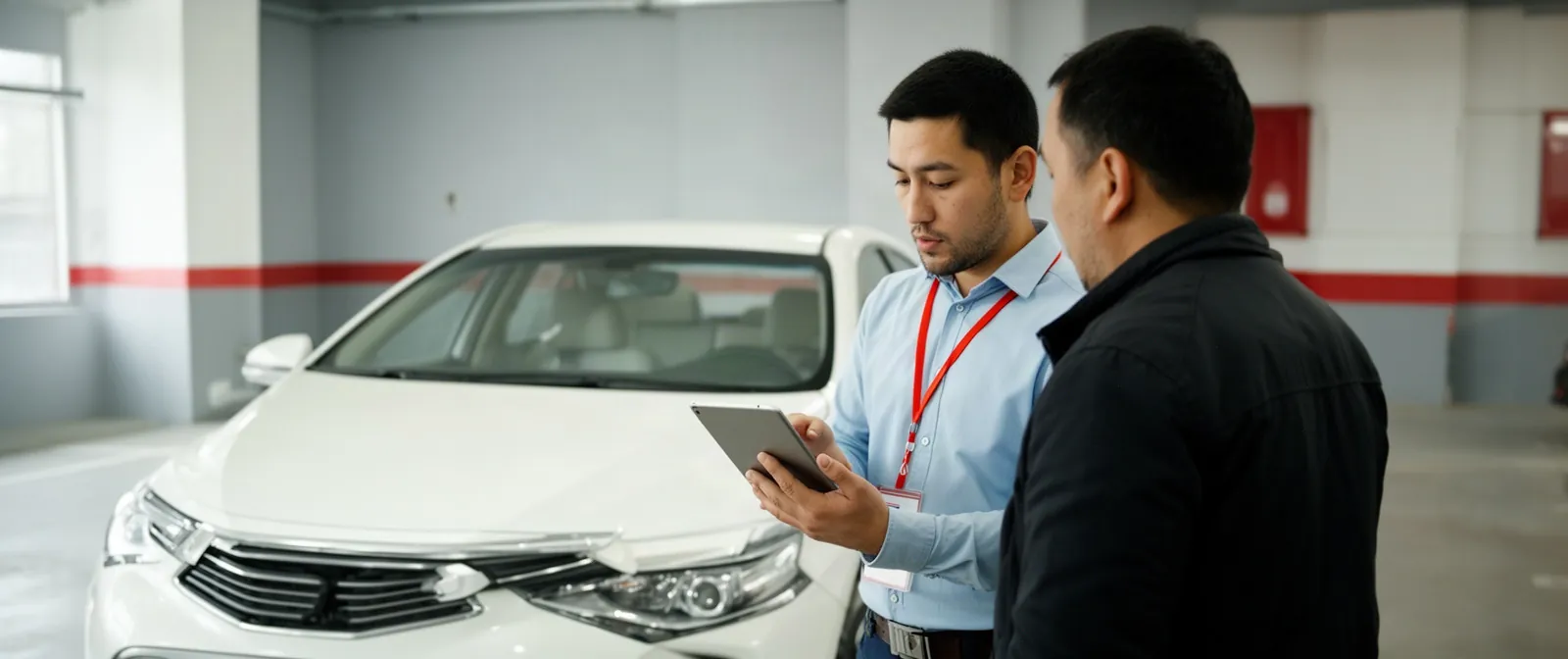
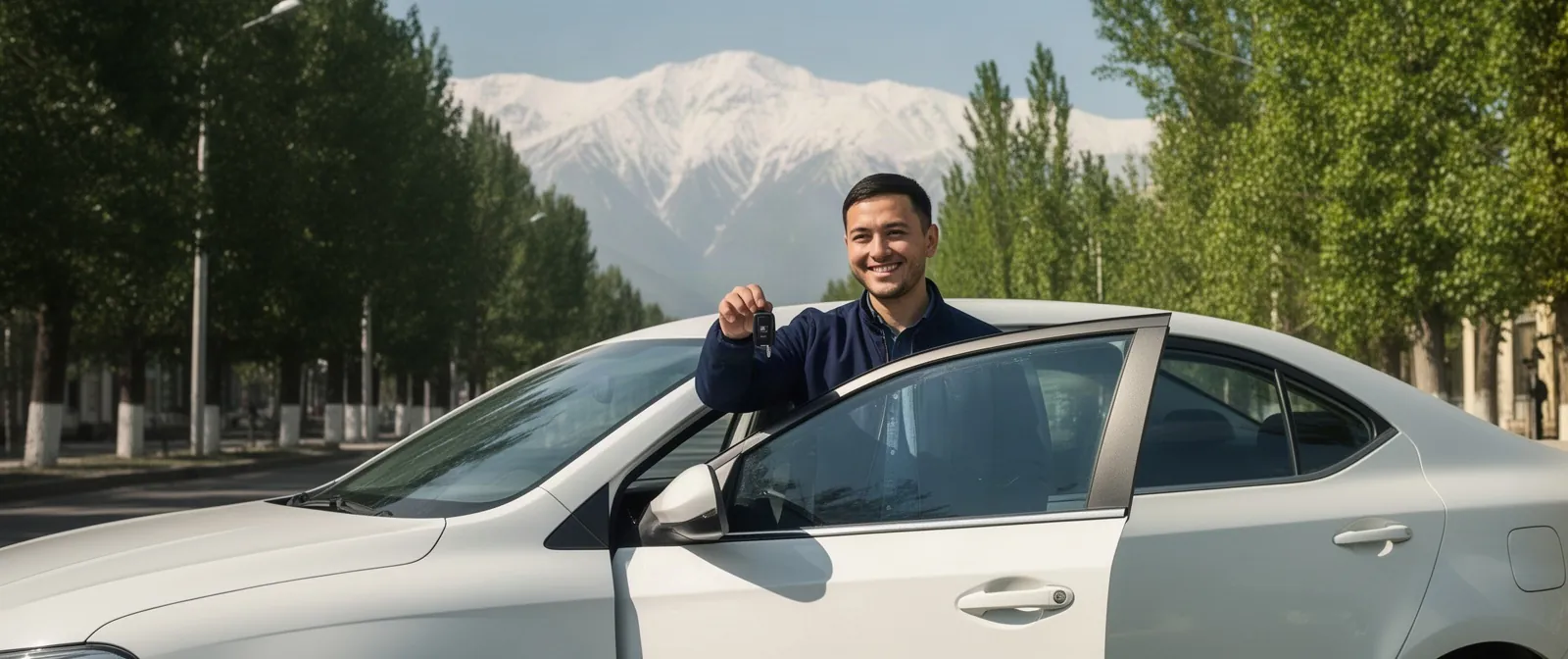
With a collateral car loan, only the registration certificate is pledged — the car itself stays with the owner, who keeps driving it. The contract names the document as the collateral, not the vehicle: the encumbrance on the registration certificate is registered in the collateral and restrictions database, while the keys and body stay with you. Car appraiser Yerlan Sagintayev inspects the car for 15 minutes — make, model, year, mileage, condition — and you immediately see the "up to" amount. You can get a preliminary appraisal by photo on WhatsApp in 5–10 minutes. This is a legal scheme: you don't lose mobility and don't pay for parking if you don't need it — driving rights are preserved for the entire loan term. A car pawnshop with driving rights is the standard format for Almaty, and we arrange it without handing the car over to the lot.
What you can and can't do with a car in collateral
- Drive and pass inspection: the car remains in your use, and you go through inspection and routine maintenance as usual.
- Insure the car: you take out the OSGPO and KASKO policies in your name — that's your responsibility as the owner.
- You can't sell it: re-registration to another owner is blocked until the loan is closed or a buyout is arranged.
- You can't pledge it again: a second encumbrance on the registration certificate won't pass the collateral database check.
- You can't remove the encumbrance retroactively: the buyer will see the collateral in the database, so close the loan or arrange a buyout first.
Driving rights or parking — comparing the two formats
| Parameter | Driving rights | Parking at Dostyk, 210 |
|---|---|---|
| Where the car is | With you | At a guarded lot |
| Mobility | Full | None |
| Parking cost | 0 ₸ | At the lot's rate |
| Risk of theft and damage | On the owner | Covered by the lot |
| Who it suits | You drive every day | The car sits idle or you're away |
| Arrangement | Collateral car loan | Loan with parking |
Parking makes sense if the car sits idle or you're away: a guarded lot removes the risk of theft and damage but takes away mobility. Both formats are legal, and the terms are fixed in the contract.
How much we give and how much you pay — amount, rate and APR with no hidden fees
The second most important question after "will they take my car" is the numbers. Car pawnshop in Almaty works on a transparent scheme: you see the amount, rate and full cost of the loan in advance. Let's break down how the collateral car loan amount is formed, what the rate consists of, and what the APR shows, so you see the total overpayment before signing.
How much money you can get secured by a car
We issue up to 20 000 000 ₸ secured by a car — that's up to 60% of market value, which is checked against Kaspi Magazin, OLX.kz and Kolesa.kz. Within that 60%, the model's liquidity sets the range: a Toyota Camry, Hyundai Tucson or Kia Sportage sells on the secondary market in 2-3 weeks, so the appraiser goes to the upper bound for them, while rare coupes and niche EVs are valued more conservatively — 45-50%. Age also cuts the amount: we accept passenger cars from 2008, and each year older reduces the base by about 4-6%. Mileage over 250 000 km and signs of body repair lower the appraisal by another 5-10%. The final amount depends not only on the car's price but also on the model's liquidity — before your visit, check your make on Kolesa.kz: the median listings for your year and mileage will show a real benchmark that the appraisal will match.
Rate, term and APR — what makes up the overpayment
Our rate is 0.19–0.25% per day, term 1–90 days, APR up to 69.35% for loans up to 45 MCI and up to 44.03% above 45 MCI. The daily rate looks modest, but the annual cost of money shows up in the APR — the full cost of the loan including all payments. The 45 MCI threshold (in Almaty this is a benchmark for large amounts) splits the rate grid: on small loans the share of fixed costs is higher, so the annual rate is also higher, while on amounts of several million it drops by almost half. The 1–90 day term with extension up to 90 days total covers scenarios from "salary in a week" to "payment to a supplier in two months". APR is convenient to compare between offers: the lower it is, the cheaper the money including all payments, not just the daily rate — ask for this figure in writing instead of relying on the advertised "percent per day".
Fees and a sample calculation — how much you repay in the end
- Appraisal and paperwork: 0 ₸ — you pay nothing for the inspection, the collateral database check, or the contract preparation.
- Interest for actual days: charged only for the days the money was in your hands, not for the entire stated term.
- Early repayment: any day, no penalty — repay on day 10 of 30 and you pay interest for 10 days, not for a month.
- Online extension: pay interest via Kaspi without visiting a branch if you need to stretch the term to 90 days.
- Example: 1 000 000 ₸ at 0,25% for 30 days, repaid on day 10 — interest will be 25 000 ₸ (1 000 000 × 0,25% × 10).
Loan or buyout — which is better if you don't plan to repay
Not everyone needs a repayable loan. If you're ready to sell your car and need the money now, buyout gives you more. Let's compare the two scenarios by amount, interest, and the fate of the car.
How car buyout differs from a loan
With buyout, Topcash pays up to 75% of the car's market value under a sale and purchase contract — no interest and no repayment term, whereas a loan gives up to 60% and requires repayment. The deal closes immediately: you hand over the registration certificate, get the money, and are no longer listed as the owner — no interest or extensions come back to you. With a collateral loan, the registration certificate stays in the safe, you keep driving, and in 30-60 days you repay the principal with interest of 0,19-0,25% per day. The difference in money is noticeable: a 2019 Toyota Camry with a market price of 12 000 000 ₸ brings 9 000 000 ₸ via buyout versus 7 200 000 ₸ via loan — 1 800 000 ₸ you'd miss out on by choosing a repayable format with no intention to repay. Buyout makes sense when you no longer need the car: those same 15 percentage points are real money, not an accounting difference.
Loan vs buyout by key parameters
| Parameter | Collateral loan | Car buyout |
|---|---|---|
| Amount | up to 60% of market price | up to 75% of market price |
| Interest | 0,19-0,25% per day | not charged |
| Term | 1-90 days | not set |
| The car | stays with the owner | goes to the buyer |
| Contract | collateral loan | sale and purchase |
| Car return | after repayment | impossible |
Use a simple rule: if you plan to buy the car back in 1-3 months, take a loan; if you're consciously parting with it, go for buyout.
Which cars we accept and how appraisal works
Not every car qualifies for collateral, and not every appraisal is fair. Here's which cars we accept, how the inspection works, and why the collateral database check protects both the client and the pawnshop.
Which cars we accept — class, age, condition
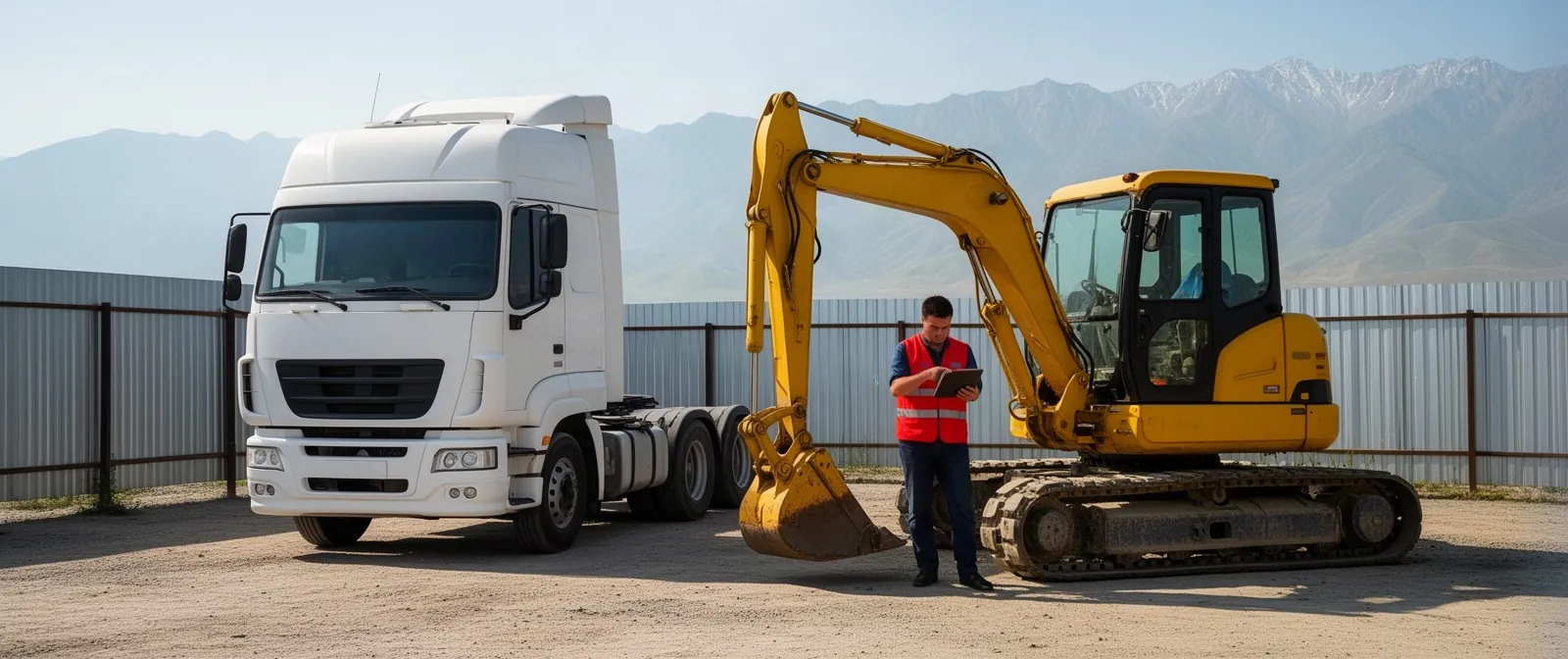
Topcash accepts passenger cars from 2008, SUVs, and commercial vehicles; trucks and special equipment — by separate appraisal. The inspection takes about 15 minutes: the appraiser checks the make, model, year, mileage, and actual condition — body, geometry, engine, suspension, interior. On the Almaty market, the most liquid are Toyota RAV4, Hyundai Tucson, and Kia Sportage crossovers from 2013–2019, as well as commercial vans and pickups that are snapped up for delivery. Age isn't the only filter: condition and model liquidity matter more, so a well-kept 2008 car can get a higher amount than a newer car with a troubled history. We issue money against a car after inspection — the appraiser names the amount on the spot, and it doesn't change when the contract is signed.
How much we give by car age and class
| Class | Age | Market price | Loan up to 60% |
|---|---|---|---|
| Economy sedan | 2015–2020 | 6 000 000 ₸ | up to 3 600 000 ₸ |
| Crossover | 2013–2019 | 12 000 000 ₸ | up to 7 200 000 ₸ |
| SUV | 2010–2018 | 20 000 000 ₸ | up to 12 000 000 ₸ |
| Commercial vehicles | 2012–2020 | 15 000 000 ₸ | up to 9 000 000 ₸ |
| Premium sedan | 2014–2020 | 30 000 000 ₸ | up to 18 000 000 ₸ |
The table is a guide: the appraiser gives the final figure after inspection, but you can get a preliminary estimate from photos on WhatsApp in 5–10 minutes. We check the market price against Kolesa.kz, OLX.kz and Kaspi Magazin — we take not the seller's listing price, but the average range of real deals for the model and year.
What we check in the collateral and restrictions database
Before signing, Topcash checks the car against the collateral and restrictions database — this protects the client from taking on a problem car as collateral. The appraiser verifies the registration certificate and VIN, runs the history through the encumbrance registry, the traffic police database and arrest records. If the car is already pledged to a bank or under arrest, the loan won't be issued: the encumbrance must be removed first, otherwise the deal is contestable and the money is at risk. In our practice, we've seen cars bought by power of attorney from a third party where the real owner was listed in the collateral database — such a car won't be accepted as collateral until it's cleared up. So before the deal, ask the seller for a printout from the collateral registry: it takes 10 minutes and costs nothing versus potentially losing both the money and the car.
Documents, requirements and 15-minute processing
Paperwork is what people fear most: it seems like processing will drag on for days. In reality, the document package is minimal, and the path from application to cash in hand takes a single visit.
What documents are needed for a car collateral loan
- National ID of Kazakhstan: the borrower's main document; foreigners can use a passport — that's enough to apply.
- Vehicle registration certificate: confirms ownership and no third-party collateral; we check it against the collateral and restrictions database.
- Presence of the owner: collateral is only registered to the person named in the registration certificate, so their participation in the deal is mandatory.
- Proof of income: not needed — Topcash reviews applications without confirming earnings.
- Credit history: not checked; we decide based on the car's appraisal, not past loans.
Borrower requirements — age, status, power of attorney
A car collateral loan is available from age 18 with a national ID of Kazakhstan, with no proof of income and no credit history check. If you drive the car by power of attorney and the owner in the registration certificate is someone else, their presence is required: collateral is only registered to the owner, and the deal can't proceed without them. A power of attorney doesn't replace ownership — it's a document for driving, not for disposing of the car. In practice it looks like this: you come together, the owner confirms consent, and the inspection and paperwork happen in your presence. Check in advance that the registration certificate has no third-party restrictions or arrests: these can only be removed through authorized agencies, and that stretches the deal out by days. If the car is leased or bought in installments with an encumbrance, settle the obligation with the lessor first.
How to get money in 15 minutes — step by step
- Appraisal from photos on WhatsApp: send photos of the car and registration certificate details — you get a reply with the amount in 5–10 minutes.
- Preliminary calculation: you see in advance how much the car collateral loan will be — up to 60% of market value, maximum 20 000 000 ₸.
- Visit to the branch: come with your national ID and registration certificate; the inspection by make, model, year, mileage and condition takes about 15 minutes.
- Check against the collateral database: the appraiser verifies the car against the restriction registries on the spot.
- Contract and money: sign the documents, get cash from the till or a transfer to Kaspi Gold, Halyk or any card in Kazakhstan.
- Prepare your registration certificate in advance: a preliminary appraisal from photos gives you a ballpark amount, and at the branch you just confirm it.
Renewal, early repayment and what happens if you're late
The money wasn't repaid on time — what next? We break down three scenarios: online renewal, early repayment and overdue. No scare tactics and no promises that don't exist.
How to renew a loan online via Kaspi
Renewal at Topcash is done online: you pay the interest via Kaspi and extend the term without visiting a branch — up to 90 days in total. Payment goes through the Kaspi Gold app or from any card in Kazakhstan, confirmation arrives on WhatsApp within 15 minutes, no branch visit needed. Here's how it works: you pay only the accrued interest for the actual days, the loan principal stays the same, and the contract is extended for a new term. The rate doesn't change on renewal — the same 0.19–0.25% per day as in the original contract. Renewal beats default: you keep your contract terms and avoid penalties, while default is calculated on a different logic.
Early repayment — how to pay back sooner and save
You can repay the loan any day with no penalty: interest is charged only for the actual days you use the money. There's no monthly payment schedule — you return the principal and interest in one sum, whenever it suits you. Example: a 1 500 000 ₸ loan secured by a car for 30 days at 0.25% per day — that's 112 500 ₸ in interest; close it on day 20 — you pay 75 000 ₸, saving 37 500 ₸. Early repayment is arranged at the branch at 210 Dostyk Ave. or by transfer to the Topcash account with WhatsApp confirmation. The sooner you close the loan, the less you pay — at 0.25% per day, repaying 10 days early saves about 2.5% of the loan amount.
What happens on default — honest about the risks
On prolonged default, the pledge holder has the right to foreclose on the collateral — meaning the car may be sold to settle the debt. Here's the mechanics: after the term stated in the contract, the lender sends a notice, then goes to court or a notary for an enforcement endorsement, after which the car is put up for auction at market price. The difference between the debt and the sale price is returned to the client — but only after the sale, and that takes weeks, not days. With a car collateral loan, the registration certificate is held by the pledge holder, so you can't sell or re-register the car during default. Default is almost always more expensive than renewal: penalties, a damaged record and the risk of losing your car — so at the first sign of trouble, it's better to agree on a renewal than to wait.
Conclusion
Here's the key things to keep in mind before the deal: from driving rights to the difference between a loan and a buyout. Below are five points that most often decide the outcome.
Key takeaways
- Driving rights are the norm, not a bonus: with a car collateral loan, only the registration certificate is held as collateral, and the car keeps driving with you.
- Look at the APR, not the daily rate: the full annual cost shows the real overpayment more honestly than 0.19–0.25% per day.
- Loan and buyout are different scenarios: if you don't plan to pay back, buyout gives up to 75% of value versus 60% for a loan and charges no interest.
- Check the car against the collateral database in advance: an encumbrance or arrest is a common reason for refusal, and it's better to find out before your visit than at the branch.
- Renewal is cheaper than default: agreeing on new terms is better than letting it come to foreclosure on the car.