








How much you really get for a diamond: how we appraise the stone
You can pawn a diamond of any size — the loan amount depends not on the store price, but on the parameters of the stone and metal. Here's what the appraiser looks at, how the amount is calculated and why the appraisal is free.
What the appraiser checks: 4C and the loan amount
| Parameter | What it means | How it affects the amount |
|---|---|---|
| Carat | Weight of the stone in carats | The greater the weight, the higher the amount — non-linearly |
| Color | From colorless to yellowish | Colorless stones are valued higher, pay more |
| Clarity | Number of inclusions | Fewer inclusions — higher appraisal |
| Cut | Stone treatment quality | A good cut boosts brilliance and price |
A large diamond with good characteristics can cost many times more than the setting, so asking for an appraisal "by gold only" is almost always a loss — check the price of the stone first.
How we determine market price and why the appraisal is free
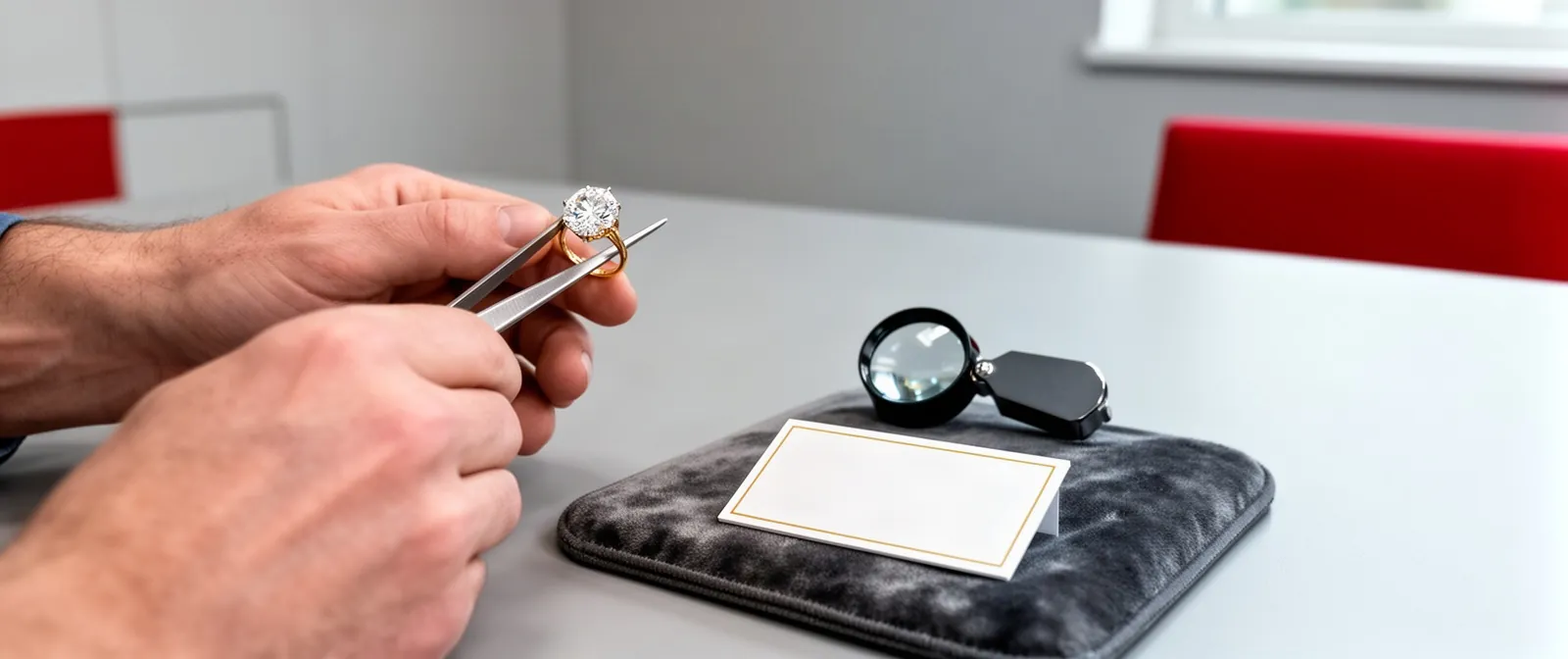
The appraiser checks the value against current listings on Kaspi Magazin and OLX.kz, and appraisal and paperwork cost 0 ₸ — no fees for inspecting the stone. Send a photo on WhatsApp and you get a price estimate in 5–10 minutes; a visit to a branch takes about 15 minutes. We check the stone in front of you: size, color, clarity and cut are measured with instruments, and we quote the total for metal and stone together. If the appraisal seems low, ask the appraiser to show which 4C parameters were used — a transparent calculation usually clears up doubts faster than haggling.
How much we pay for a ring with a 0.5-carat diamond
The exact amount for a ring with a 0.5-carat diamond is quoted after checking the stone in front of you: it's based on the stone's price by 4C plus the gold value by purity. We also accept stones without a certificate — instruments will show the weight, color and clarity, and the amount will be slightly more cautious, but still higher than for metal alone. Send a photo of the ring on WhatsApp — in 5–10 minutes you'll get a price estimate so you can decide whether to visit a branch before even leaving home.
Diamond without a certificate: will you accept it and how is the amount calculated
No certificate is not a refusal, just a different way of appraisal. We explain how a stone without papers is checked and why the final amount is still higher than the price of metal alone.
Do we accept diamonds without a certificate
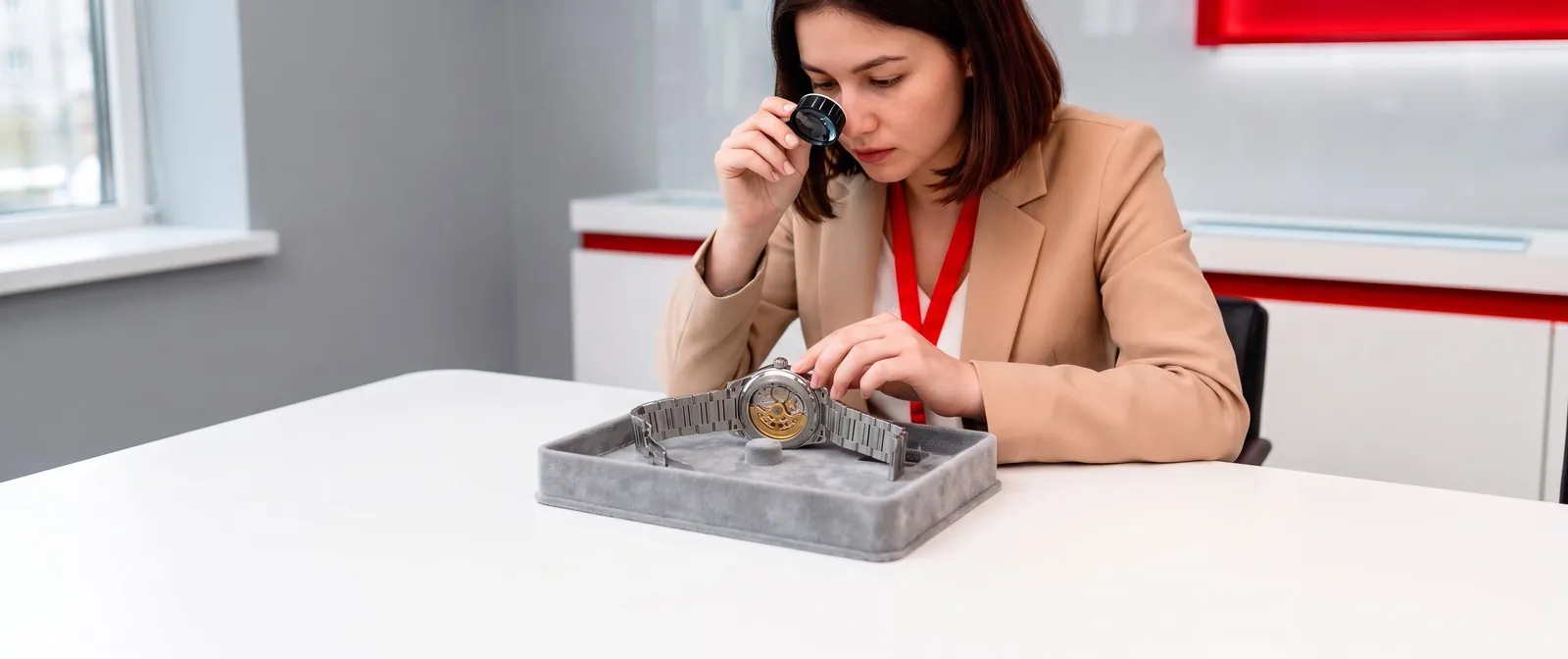
Yes, we accept diamonds without a certificate: the appraiser checks the stone with instruments in front of you and determines weight, color and clarity right at the branch. The inspection takes 5-10 minutes using a refractometer, a 10x magnifying loupe and a thermal conductivity tester — they distinguish a natural diamond from cubic zirconia and moissanite. The diamond is appraised separately from the setting: first it's weighed on carat scales, then the color is checked against a reference scale and inclusions are noted. The metal is valued by purity — 585 or 750 gold, platinum. Without a certificate the amount is calculated a bit more cautiously, but still higher than the metal price — the stone counts as a value of its own and doesn't "burn" in the setting.
GIA and IGI certificates: what they give and when they're not needed
- What it confirms: a GIA or IGI certificate records carat weight, color, clarity and cut quality on an independent laboratory scale — it's outside verification, not the seller's claim.
- What it speeds up: with the paper, the appraiser checks the stated parameters against the stone with instruments and processes the loan faster — without full initial diagnostics.
- When it's not needed: for small stones up to 0.3 carats — the parameters are confirmed by instruments anyway, and the paper barely affects the amount.
- When it's critical: for a large diamond of a carat or more, the certificate records characteristics that are hard to confirm by eye and helps get a higher appraisal.
- What to do without the paper: the appraiser will determine weight, color and clarity in front of you — no refusal due to a missing certificate.
With certificate vs without: how the amount changes
| Parameter | With certificate | Without certificate |
|---|---|---|
| Do we accept? | Yes | Yes |
| How we appraise | By certificate + instruments | Instruments only, in front of you |
| Amount | Base | A bit more cautious, above metal price |
With a certificate we appraise the diamond by the stated characteristics plus check it with instruments; without one — by instruments only, so the amount may be slightly lower. The difference usually isn't critical for small stones up to 0.3 carats, but for a large diamond it's worth looking for the certificate in your documents — it directly affects the final figure. The parameters of the stone and metal are recorded in the collateral contract before signing, so that on return the item matches all characteristics.
Stone or metal: what's more profitable to appraise separately
Many ask to appraise an item "as gold" and lose money. We show when the stone is worth many times more than the setting and how this affects the loan.
What's more profitable — stone or gold
Appraising a diamond separately is more profitable: a large stone is often worth several times more than the metal, and we price the setting and the gold together, not just by purity. 585 gold keeps its value at 25 000–30 000 ₸ per gram, while a stone of 0.5 carat and up with good color and clarity can add 300 000 ₸ or more to the appraisal — a gap in favor of the stone of up to ten times. In jewelry with a small scatter (up to 0.1 carat per stone), the weight of the gold becomes the main factor: a 5-gram setting gives more than twenty micro-stones. The appraiser measures the diamond with a device in front of you, checks color, clarity and cut, then adds up two amounts — for the metal and for the setting. If the stone is small or damaged, an appraisal “as gold” may be comparable — the appraiser will tell you which option pays more in your case.
Ring with a diamond: the stone separately or all as gold
We accept a ring with a diamond at the pawnshop in two ways: with the stone appraised separately or the whole piece as gold — the choice is yours, but the first option is usually more profitable.
- Stone separately: the appraiser measures carat weight, color, clarity and cut, then weighs the setting metal separately — we add up both values.
- All as gold: we count only the weight and purity of the metal, the stone is not factored in — suitable for small scatter and heavily worn jewelry.
- What to bring: your national ID, the ring itself and, if you have one, the stone certificate — it will speed up the parameter check.
- Size doesn't matter: the fit on the finger doesn't affect the appraisal — we care about the stone and the metal, not the circumference.
- Term: appraisal is free, paperwork takes about fifteen minutes, money — in cash from the till or by card transfer.
Diamonds in silver and without a setting: what we accept
We accept diamonds in jewelry and without a setting, in gold and silver — the stone is appraised by the 4C regardless of the metal it is set in. 925 silver on its own is not worth much, but a diamond of 0.3 carat and up with good VS clarity and G–H color makes up the bulk of the sum, while the metal adds just a few percent. We accept loose stones in a separate bag: the appraiser measures the weight on carat scales, checks color and clarity under a loupe and with a device, and verifies the cut under a microscope. A GIA or IGI certificate speeds up the check but is not required — the parameters can be read without it. A loose stone is sometimes easier to appraise: it is not covered by a setting, and devices read the parameters more accurately, which can give a slightly higher sum.
Protection against swapping and collateral storage: how we guarantee safekeeping
The client's main fear is whether they will get back the same piece. We explain how the stone's parameters are recorded in the contract, what happens to the jewelry after sealing, and how to get the collateral back even the next day.
How to be sure the stone won't be swapped
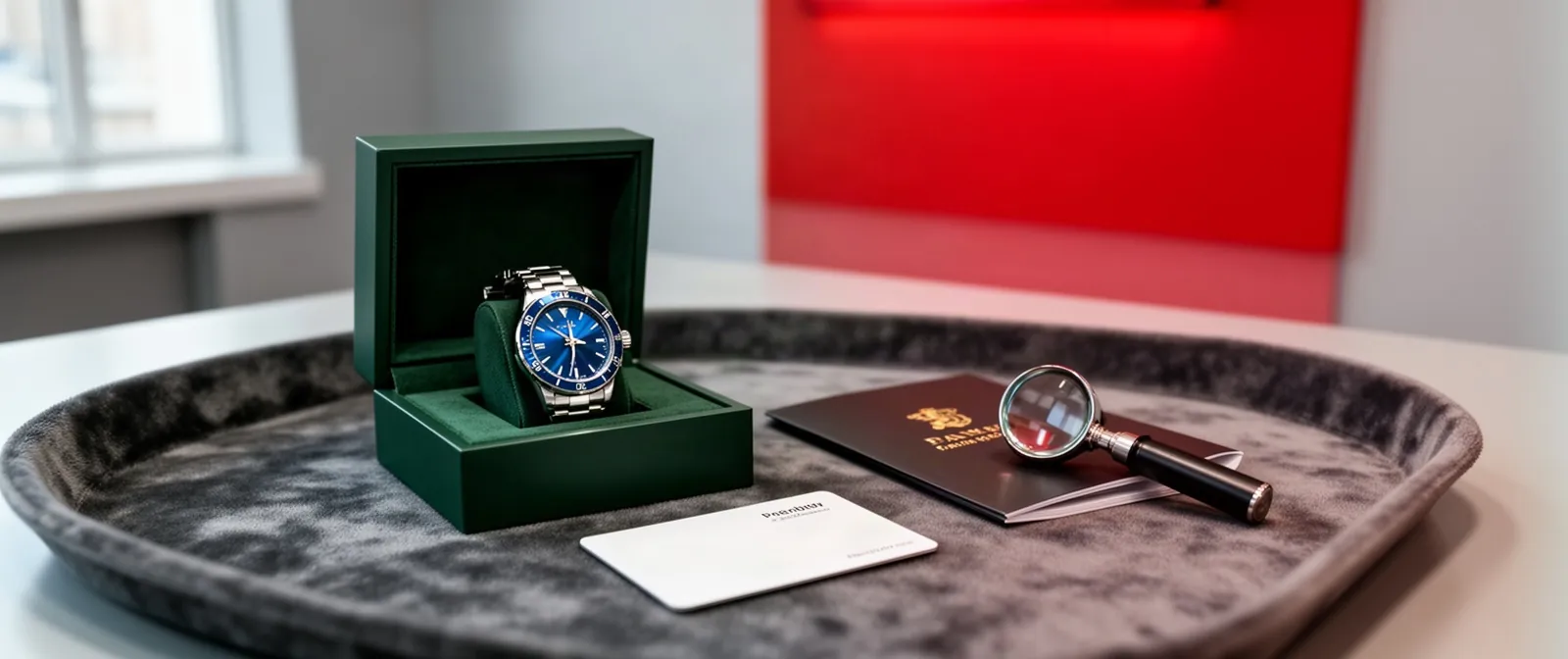
Before storage we record the diamond's parameters in the contract and pack the piece in a sealed bag with your signature — we open it only in your presence. In the collateral contract we enter the weight in carats, color, clarity, cut type and a description of the metal: for a ring with a 0.5-carat diamond these are separate lines for the setting and for 585 gold. The appraiser checks the parameters in front of you with devices — a refractometer and carat scales — and enters the result in the report. After signing, the piece goes into a sealed bag: your signature and the contract number are placed on it, and any opening is logged. Ask to be shown exactly how the bag is sealed — your personal signature on the bag makes any swap technically impossible without your involvement.
Where the collateral is stored and whether it is insured
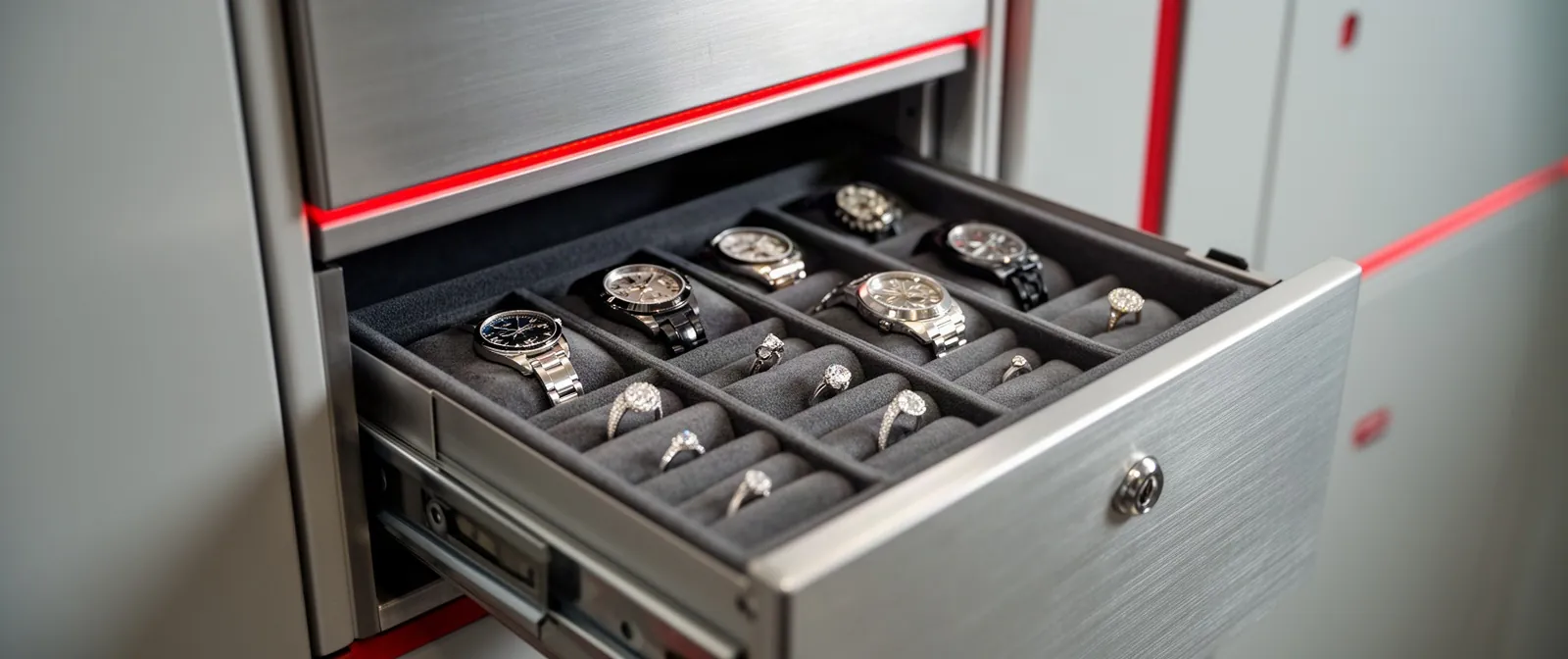
- Own safe: the collateral (except cars) never leaves the branch — the jewelry stays in the pawnshop's safe until it is returned.
- Insurance: the piece is insured for the appraisal amount stated in the collateral contract.
- Sealing: gold and stones are packed in a bag with the client's signature and the contract number.
- Returned as received: when the loan is repaid, the piece is returned in exactly the condition it was accepted in.
- Check on issue: before returning, we verify the stone and metal parameters against the report together with you.
Can you pawn a diamond and buy it back right away
Yes, we allow early repayment any day with no penalty — interest is charged only for the actual days, so you can buy the item back even the next day. At a rate of 0.19–0.25% per day, one day of using a 500,000 ₸ loan costs about 950–1250 ₸ in interest — that's the entire fee to buy a diamond ring back. There's no monthly payment schedule: you repay the principal and interest in one payment on any convenient day within the 1–90 day term. If you don't plan to get the item back, there's a second option — selling it right away under a purchase agreement, where we pay about 10% more than the loan amount. Before signing, ask the appraiser for both amounts — the loan and the immediate sale — the difference is usually noticeable on large stones from 0.7 carats.
Interest, terms and conditions of a collateral loan secured by diamonds
Rate, term, APR and repayment procedure — four numbers that determine the real cost of a loan. Below is how they work and what happens if you fail to buy the item back on time.
Rate, term and APR: what a loan costs
We issue collateral loans secured by diamonds at a rate of 0.19–0.25% per day for a term of 1–90 days; APR — up to 69.35% for loans up to 45 MRP and up to 44.03% above 45 MRP. The rate within the range depends on the loan amount: loans from 45 MRP (calculated on the date of issuance) get the lower bound. For a diamond ring appraised at 800 000 ₸, daily interest will range from 1 520 to 2 000 ₸. The upper APR bound applies to short small-sum loans, where fixed costs are spread over just a few days. There is no monthly payment schedule — repayment is a one-time payment at the end of the term or early on any day, so the overpayment depends only on how many days you actually use the money.
What happens if you don't buy the diamond back on time
- Online extension: if the loan term is coming to an end, we offer to extend the contract — you can pay the interest via Kaspi without visiting a branch, and the collateral stays in the safe for a new term.
- Extension term: the contract is extended for the same period as the original loan — from 1 to 90 days, and the principal amount stays the same.
- Transfer of ownership: if the extension is not arranged and the loan is not repaid, the item becomes the pawnshop's property under the terms of the collateral contract.
- Keeping the buyout option: an extension is better than transfer of ownership — you keep both the stone and the option to buy it back later for the same loan amount.
- What is fixed in advance: the end date and extension procedure are set out in the contract at issuance, not added retroactively.
Loan or immediate sale: comparing the terms
| Parameter | Collateral loan | Immediate sale |
|---|---|---|
| Interest | 0.19–0.25% per day | No interest |
| Term | 1–90 days | No terms |
| Amount | Base appraisal | ~+10% to the loan amount |
| Return of the item | Yes, after repayment | No |
A collateral loan keeps your right of buyout, while an immediate sale under a purchase agreement gives you about 10% more than the loan amount, but the item stays with us forever. Choose a loan if the stone is precious as a memory or you plan to buy it back after payday; choose a sale if you don't need the item and want the maximum amount here and now.
Documents, speed and where to pawn a diamond in Almaty
What to bring, how long to wait for the money and where to go — three questions that decide whether the deal happens the same day. Below are the client requirements, processing speed and branch addresses in the city.
What documents are needed and from what age
- National ID of the Republic of Kazakhstan: the main document for a loan with us; we also accept a passport, and require no other papers.
- Age 18 and over: we do not serve younger clients — this is a requirement of the microcredit license.
- Proof of income: not needed — the collateral itself confirms solvency, not your earnings.
- Credit history: we do not request it and do not affect it — a bank refusal does not close off access to a loan.
- Power of attorney: required if the item is registered to another person — without it we will not complete the deal.
How to get money fast: 15 minutes, 24/7
Photo appraisal on WhatsApp takes 5–10 minutes, processing at the branch about 15 minutes, and we pay out cash from the till or by transfer to Kaspi Gold, Halyk or any Kazakhstani card. Send a photo of the stone and the tag to our WhatsApp number — the appraiser will give a preliminary amount before you arrive. At the branch, they'll check the stone with instruments in front of you: size, color, clarity and cut — then you sign the contract and get your money. All 6 branches of the network are open 24/7 with no days off, so you can come late in the evening or on a weekend — you need money today, not "during business hours." If the photo appraisal and the in-branch inspection differ by more than 10%, ask for a recalculation in front of you — the difference usually means inclusions or a chip weren't visible in the photo.
Where to sell a diamond in Almaty: addresses and license
The diamond pawnshop in Almaty spans 6 24/7 locations: the main branch is Abylai Khan Ave, 91 in the Almaly district, the car pawnshop is Dostyk Ave, 210; we operate under ARDFM license No. 02.26.0041.L. The license is issued for collateral microlending, so the loan contract here isn't a receipt but a document with registration details. The branches are spread across districts so that the nearest one is no more than a 20-minute drive from anywhere in the city. Before you set off, message us on WhatsApp — the appraiser will point you to the nearest branch and a preliminary amount, so you don't drive blind.
Conclusion
Here's the key that determines the amount and your peace of mind in a diamond deal. The five points below are a quick summary of appraisal, storage, and deal terms.
Key takeaways
- Appraisal is based on the stone, not the retail price. The amount is set by the 4Cs — carat, color, clarity, and cut — plus the metal value by purity.
- A certificate helps but isn't required. A stone without papers is checked with instruments in front of you, and it's still valued above the metal price alone.
- A stone separately is worth more than the metal. A large diamond is often worth several times the setting, so asking for a "gold" appraisal only makes sense for small melee.
- Collateral safety is documented. The stone's parameters in the contract and a sealed bag with your signature prevent swapping.
- Terms are transparent upfront. The rate, term, and repayment procedure are known before signing, and early buyout has no penalty.